The heavy-duty trucking industry has a big demand for qualified truck drivers. There is also a need for qualified mechanics/technicians that are knowledgeable in repair work and know to use quality replacement diesel engine spare parts. If you like this world and the truck maybe you have to study a truck driver career
The freedom of the open road and driving cross country hauling freight doesn’t appeal to the younger generation. Most people, myself included, look to pass trucks while on the freeway and hate getting stuck behind them.
Short-haul driving (within city limits) doesn’t appear to be that appealing either. No one likes traffic, to begin with, and being stuck in the city with a truck & trailer three times the size of the average car daily doesn’t sound fun.
Truckinginfo.com posted an article in December of 2013 titled “Commentary:
The Ever-Pressing Need for Young Drivers and Technicians”. This article mentions that the average age of current drivers is 55+, as provided by the Bureau of Labor Statistics. It’s also mentioned that by 2020, there can be a need for 330,000 new drivers.
How to become in a heavy-duty truck driver

1. Requirements
If you want to become a truck driver you have to accomplish these requirements for the school you are gonna apply.
Obtain a CDL
The first step is to obtain a Commercial Driver’s License (CDL) from your state of residence, which comes with its own set of requirements.
Attend a Truck Driving School
To earn a CDL, you’ll have to attend a truck driving school. Each school may have slight variations in its truck driver requirements, but there are a few qualifications that are consistent across the board. If you’re wondering where the nearest school is or how you’ll pay for school.
Clean Driving Record & Solid Work History
Most truck driving schools require a clean driving record and a solid work history to enter their programs. Want more information on truck driver qualifications in your state? Pick up a copy of your state’s commercial driver’s manual at your local Department of Motor Vehicles (DMV) to become familiar with commercial driving rules and regulations.
Be at least 21 Years Old
The Department of Transportation (DOT) requires all professional truck drivers to be at least 21 years old.
Pass a Drug & Alcohol Test & Undergo a Physical
Prospective drivers also have to pass a drug and alcohol test and undergo a physical by an approved doctor before receiving their CDL.
2. Find a truck driver school

You have to find a good school that teaches you the necessary skills to be an excellent and prepared truck driver.
3. After you complete your preparation you have to find a job as a truck driver.
You can apply for this job on the Internet or in Institutions of truck drivers in your country.
We provide you some free job boards for this career on this web page.
3 benefits of the truck driver career
1. Stability and good pay
With a truck driver career, you have a lot of work opportunities in different companies and the job is well paid.
The median annual wage for a trucker that works for a private fleet,
such as a truck driver employed by Walmart, is $73,000, according to ATA.
The Labor Department pegs the median annual salary for all truck drivers at around $40,000.

2. Traveling.
As a truck driver you are gonna have a lot of travels and adventures around your country, that´s the reason why a lot of truck drivers love their jobs.
3.Freedom
you are not going to have a boss or other people disturbing you, you don´t have to deal with other employees or other things like that. You can take different ways to do your job, for example, you can be a local driver, a road driver, tanker driver and other different opportunities that you have as a truck driver.
Here are some misconceptions of being a truck driver:

- The stigma of super long days or terrible hours.
Most truckers will work longer days on average than most, but with new safety regulations and limits on how many hours a trucker can drive, it’s not as bad as it used to be. Trucking companies will need drivers at all times of the day, so different shifts are available. - Older trucks are not the easiest to drive.
While driving a manual transmission truck does take more focus and concentration, many newer trucks have automatic transmissions, so they will be easier to drive. - Short Haul drivers complain the company does not have enough drivers, hours are too long and not being appreciated.
Estimated shortage
Wikipedia noted that in 2005 there was an estimated shortage of 20,000 drivers and expected this number to increase to 111,000 by 2014. At one point, driver turnover for trucking companies was 136%. More drivers were either retiring, quitting, or being let go, they’re being hired as replacements or new drivers. It’s no
surprise that the short-haul drivers complain as they do.
The article from Truckinginfo.com goes on to mention that the need for technicians/mechanics is worse than the need for drivers. The Department of Labor estimated 10 years ago there were 606,000 diesel technicians and the industry would need 205,000 more by 2014 to fill new positions and replace retirees.
Repair work
While the weight of diesel engine spare parts may not be a good reason, the complexity of the parts can be one. Also, the repair work may be harder compared to the automotive. Diesel engines and their spare parts are bigger/heavier than automotive engines and parts, but the repair processes are very similar.
When people think of a diesel mechanic, their first thought is probably of an overweight older gentleman, covered with grease spots and an outdated workshop. There are probably places like this, but most certified repair shops are very clean and professional.
Importantly the pay scale for drivers and technicians is comparable to other careers and geographical areas.
Years of experience and quality of work can be factors as well.
So, how can the shortage be overcome?

Creating more public awareness about the positives involved with being a truck driver or technician is one way. Having programs that can reach out and educate high school kids about careers in these fields can go a long way. Not all high school kids go on to college. Some kids may look at going to vocational schools for specialized training or they learn on the job.
Big time truck builders such as “Navistar, Peterbilt and Volvo” have established alliances or vocational training programs with schools like Universal Technical Institute (UTI) or Wyotech to help improve and educate recruits for a career as a diesel technician.
If you are at a crossroads in life or just looking for a career change, there is plenty of room in the trucking industry as a driver or technician.

As a purchasing manager for an aftermarket heavy duty replacement truck parts supplier, it is my responsibility to research parts and determine the best parts to add to the inventory.
There are many factors to consider when it comes to adding parts to existing inventory. Age of the part, demand for the part, and quality sourcing are all important. Knowing what parts to start with and the basic information of the part are crucial.
Listening to customers is one of the best ways to figure out what new parts are on the rise. Customers at some point in time will ask the salesforce about a part number that is not in stock or currently available by the company. When this happens, is your salesforce prepared to get the information you will need to make it easier to research the part in question?
Here is a list of questions the salesforce team can ask the customer:
How often do you sell this particular part?
Product demand will help in determining a part. You wouldn’t want to add something that a customer only replaces once a year.
What year is the truck?
Newer trucks will have manufacturer warranties up to 5 years or more. During this time, parts are covered by the warranty, so aftermarket heavy duty replacement truck parts are not needed until the warranty is expired. There is not many older trucks, 35 years or older, that are still roadworthy. Adding new inventory parts for trucks this old would not make sense.
Do you see a wide variety of this type of truck or engine types?
Different geographical areas tend to see more of one type of truck/engine than another. One customer could see more Aftermarket Detroit Diesel engines versus Mack engines.
What is the OEM cost to replace the part?
Aftermarket options need to be of good quality, but also need to be priced as such that it is worth going with the aftermarket part instead of OEM.
Besides polling the salesmen for information, reviewing customer purchase history can be useful. If a customer is purchasing many types of Aftermarket Cummins heavy duty truck replacement parts, you can conclude that they would be open to more Aftermarket Cummins part options.
Let’s say you have a list of some part numbers to research. This list was finalized after speaking with your salesforce and reviewing customer histories, but you are still unsure if you should add this part. Another way to get some information on a part is by doing a ‘Google’ or other web browser search.
Type the part number and part type in the search bar and see what comes up. If the first few pages show multiple listings of this part for retail sale, whether it’s used, remanufactured or new, you more than likely are looking at a part number that is in demand now.
If all you come across in your search are overseas companies looking to sell this part number and no retail listings, you may have an oddball part that isn’t in demand. Either this, or the part is still being covered by manufacturer warranty and will not be in demand for a while. It could be possible that you are using an older part number and should check for alternates to confirm.
Before you add any heavy duty replacement truck parts, be sure you research the parts very carefully, then look for your sourcing options.
You have had your truck for many years now and during routine maintenance of your vehicle, you realize that your exhaust manifold is leaking. Let’s say it’s at a point where you can’t repair the leak, which means you have to replace it.
As you are beginning to inquiry about a new exhaust manifold, your parts supplier asks you if you want ‘Cast Iron’ or ‘Steel’. Would you be able to answer this right away? The OEM manifold that was removed from your truck is more than likely cast iron, so why would you be offered a steel version?
Here is some information that can help you make a decision.
Cast Iron
- The material is inexpensive and fairly easy to work with. OEM manufacturers tend to use cast iron because of this.
- Material is durable and can have a long life span.
- It is heavier than steel and can become brittle and prone to cracking under extreme heat cycles and age.
- Requires special tooling for production, but is easier for mass production.
Steel:
- Steel has different options, mild steel or stainless steel
- Mild steel has a ‘low degree to thermal expansion’ and is an excellent choice for flanges.
- Stainless steel is stronger and more corrosion resistant than mild steel, and also costs more.
- Stainless steel can be prone to expanding during heat cycles, then retracting when cooling. This can rip off the bolts or studs that hold the exhaust system together.
- Can be used to make traditional log style exhaust manifold, but is better suited for custom made tubular exhaust manifolds, without special tooling needed.
Steel exhaust manifolds can reduce heat loss, especially stainless steel versions, which can lead to an added increase in horsepower and performance. You can add a ceramic coating to cast iron exhaust manifolds for a small increase, but not as much as you would gain with steel versions, which can also be given a ceramic coating.
The decision to replace your exhaust manifold and what type of replacement to go with can depend on many factors.
- How long do you plan to keep the truck?
- Do you want increased performance and more horsepower?
- What does your budget look like?
Now that you are more informed, you can choose the best option that fits your needs.

Maintenance of Heavy Duty Trucks
Trucks are a great heavy duty vehicle that has made it possible to transport diverse goods from one place to another. However, they are a big investment, but the maintenance, insurance, and many other factors add to the cost as well.
Because maintaining their parts is an important aspect of keeping trucks on the road. As well made as the parts of a truck may be, they eventually need replacement due to wear.
For freight companies, the key is to replace parts before they break, resulting in having to leave a rig on the side of the road.
Hence, even when routine maintenance is performed, parts will eventually wear out. When this happens, you need to know where to get replacement parts for your trucks.
Although finding parts for used heavy trucks is more challenging than finding parts for a car, there are several good places to source them if you’re willing to do some research.
Thus, a supplier of medium and heavy truck parts will assist with this task, but carriers must choose a parts supplier carefully regarding the fleet services they need.
Below are some diesel engine trucks part that crucial to always take good care of.
Brakes
Knowing how to properly use the brakes will greatly decrease strain on the truck’s system and use far less fuel during even the longest drives.
Many people use the brakes far more than necessary during drives, which is especially true in traffic since they continually accelerate and brake to move forward.
Learning to coast the vehicle can make a significant difference in the amount and regularity of fuel fills.
Flywheels
A truck flywheel may not be familiar to most people, but it is an important part of the truck. The car flywheels are fairly durable one-piece components.
They operate primarily to provide the inertia necessary to carry the engine’s pistons through the unproductive stroke of their cусlе.
Thе teeth that surround the flywheel are used by the starter motor to turn the engine until the engine fires up.
Therefore, they will need replacement if the teeth on the flywheel become worn. There are many signs of the bad car flywheels.
Shock Absorbers
Having good shocks for your used heavy trucks can mean the difference between a controlled drive and one that leaves the driver in a panic.
The shock absorbers affect handling and just about everything else that has a close relationship with the axle, so don’t let them slide.
Make sure the shock absorption is operating by the manufacturer’s recommendations and check them regularly to see if they are іn nеed of replacing.
Proper shock absorbers can cost anything from a few hundred dollars to over a thousand, but take care of thеm, аnd they’ll take care of you.
Thus, Standard rebuild kits which include the following items: cylinder kits (pistons, liners, rings, retainers), main bearings, connecting rod bearings, a head or upper gasket set, rocker cover gasket, and an oil pan gasket.
Commonly needed items also include thermostats, head bolts, camshaft bearings, water pumps, oil pumps, and fuel injectors and Aftermarket Cummins Oil Pan M11.
Maintaining your truck with the best parts is a way to prevent your heavy-duty truck from breaking down. Inform yourself and always do your research and notice any change when driving your truck.
Knowledge is power, and with the right information, you can keep your diesel engine truck running optimally, for less.

What Does It Mean to You?
In January of this year, a new Memo of Understanding (MOU) was reached between a number of medium and heavy duty commercial vehicle manufacturers and the Aftermarket providers of vehicle service. This historic agreement applies to the OEM release of all technical information and programming protocols necessary to maintain the emission controls on the vehicles to which it applies.
What this means is that the maintenance of the complex integrated emission controls, such as on-board computers, EGR valves and EGR coolers, exhaust manifolds and piping, diesel particulate filters and selective catalytic reduction systems, are now to be maintained by ANY facility that purchases licenses from the vehicle and engine manufacturers who provide the original components. The agreement applies to medium and heavy duty vehicles over 14,000 GVW and manufactured after 2009. It excludes motor homes and vehicles with off road engines.
The first laws concerning RTR were enacted by the State of Massachusetts. The new MOU is not legally binding, but is an indication of the recognition of the need for freedom of maintenance choices by owners of commercial trucks. It also provides the means by which every heavy duty vehicle will remain emissions compliant throughout its years of service. Below are some examples of the need for constant vigilance for the causes of emission control failure:
In the first photo, the EGR cooler jacket has become clogged with diesel particulate matter (PM or Soot).
In the second photo the EGR cooler has cracked internally and allowed coolant to leak into the entire exhaust system and into the engine oil.
The provisions of the MOU are extensive and very important for the repair facility to understand and apply. They include:
1. The OEs will supply the same information and same limitations that they give to their dealers.
These include:
- Location of critical sensors.
- Wiring diagrams.
- Ability to reflash on-board computers.
- As-built VIN to OE part number information, often called line settings.
- Any specialized tools.
- The OEs WILL NOT SUPPLY TRAINING.
2. Licensing at fair and reasonable prices.
3. Light/HD OEs may adopt the existing automotive MOU.
Implementing the RTR requires attention to the makes and models for which licensing should be sought. The licenses are not inexpensive. Secondly, extensive training of expert technicians is required if reprogramming of vehicles is contemplated. Every OE has its own protocol which can be run off of the same PC with common interface cabling as long as the licensed software has been downloaded.
With this momentous agreement, the entire vehicle service industry should now be able to agree on common practices that insure the quality of maintenance required in today’s commercial vehicles.
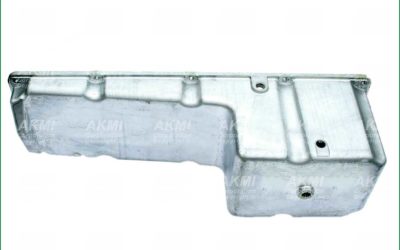
In recent reviews of diesel engine parts demand, it was surprising to learn from at least one company, AKMI Corporation, that there has been a high demand for oil pans on certain diesel models. What could cause such demand? Consider the possibility that the aftertreatment system is involved.
A check of recent technical service bulletins revealed that there is, indeed, a relationship among diesel aftertreatment malfunctions and engine oil condition. Not surprisingly, there is also a direct relationship between combustion malfunctions and engine oil quality. The following are some examples.
“If exhaust backpressure exceeds specifications, it is an indication that the DOC (Diesel Oxidation Catalyst) is face plugged. If a malfunction caused coolant to enter the exhaust system, it might become necessary to replace the DPF (Diesel Particulate Filter)”. In other words, the malfunctions in the aftertreatment system could cause exhaust backpressures to exceed the high limit. That, of course, leads to excessive combustion particulate matter (PM) to be forced past the piston rings and into the engine oil. Here are some photos that illustrate the aftertreatment component malfunctions.

Other bulletins refer to problems in the combustion chamber. One cites “carbon packing on the piston top land”. Another indicates a problem with “vertical liner lobing”. Both lead to excessive oil consumption. We can assume that they also lead to compromised combustion and higher soot levels, which would find their way into the oil pan.
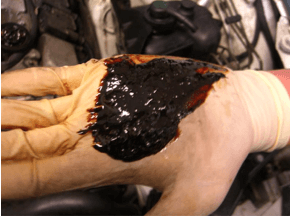
So what do the above problems have to do with oil pan replacements. Simply put, the pan replacements could be due to alert service personnel going further than just changing contaminated oil. It is likely that they are pulling the oil pan as well and finding massive sludge deposits, such as shown in the upper photograph. That leads them to replace the pan and gaskets. It’s the sure way to deliver clean oil to the engine, without it being contaminated further from continuous suction of sludge by the oil pump and overloading of the oil filter.
The extended effects of the sludge contamination include turbocharger bearing failure and excessive cylinder wear. Where engine oil is compromised, many aspects of engine durability and performance will suffer.
What do you consider the most important engine part for your truck? Think of a part that your truck absolutely needs and can’t survive without. There are many different answers that can be given – cylinder block, crankshaft, camshafts, flywheel, exhaust manifold, EGR cooler, etc… (HINT…Oil Pan) I am sure that you can think of a few others that I haven’t listed. Pointing out one part exclusively is just too hard, so what would you list in your Top 5.
Now I ask, as you thought of your Top 5 engine parts, did the oil pan make your list?
No, why not? Is it too simple of a part for you to consider or is it because, unlike the crankshaft which has a vital role in engine movement, the oil pan just sits at the bottom of the engine block and has no “functional” use?
Myself, I would rank the oil pan in the Top 5 of the most important engine parts needed.
Even though it doesn’t connect with any moving parts, no gears to mesh with other gears, which in turn operate other parts, the purpose of the oil pan itself is vital. It stores one of the most important fluids your engine needs, which is OIL.
Without oil, all the other parts you can think of would not work to maximum efficiency and would eventually cause the engine to seize. Engine oil lubricates metal parts in the engines, so there is no metal grinding of parts. Without oil, these metal parts would grind against each other, causing small bits of metal to break off. Without proper lubrication, parts like the crankshaft, camshaft, and others would eventually seize up rendering the engine useless.
They store this crucial fluid, up to as much as 9 gallons of oil on Class 8 trucks. This much oil is needed as it does tend to breakdown and become thinner as the engine is used more. Oil pumps create a suction, pulling oil from the oil pan, running it through an oil filter, then through the engine before it ends up back in the oil pan.
If it is leaking, this could cause problems. Common leaks are gasket failure, drain plug or weld not secure causing a leak, or oil pan was hit and became cracked. Once an oil leak is discovered, then it’s very important to find the leak and fix it immediately. Sometimes this means having to replace your oil pan.
Overall, the oil pan is a very important and vital part of an engine, regardless of if it makes your Top 5 or not.
This isn’t because it’s a complex engine part with moving gears, but because the oil pan is responsible for storing one of the engines most vital fluids when it comes to function and performance.
Note: Below are links to Akmi oil pans by manufacturer:

Braking System of your Heavy Duty Truck
Of all the vital pieces of safety component that come with your heavy-duty truck, as the brake is onе of the mоѕt сrіtical partѕ оf your vehicle that have a direct effect on the performance of your truck-stopping system.
Hence, Brake pads should regularly be inspected for the possibility of wear out and should probably be the most crucial component to take good care of.
That is not to say that many other parts of your vehicle should be treated as less important but for everyday motorists with little.
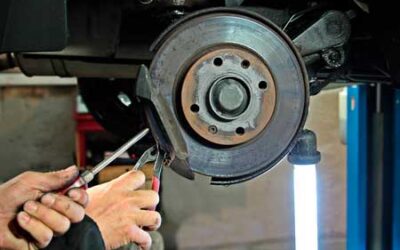
However, most of the time, you can notice brake pad wear without having to remove the wheel.
Thus, having a firm and efficient rear brake system will undoubtedly save you a lot of money compared to being reckless. Maintaining your truck brake system will assure a good driving experience.
Many kinds of heavy-duty trucks have rear brakes that have a rotor, or a big flywheel, as well as a caliper that holds the brake shoes to the rotor.
However, modern trucks have power brakes that are assisted with a power brake booster between the brake pedal and the master cylinder.
The power brake booster usually looks like a black cylinder near the back of the engine compartment.
The Powe Brake Booster
The power brake booster is an ingenious little vacuum booster. It takes vacuum from the engine to provide an increase in leverage.
In layman’s terms, it allows your foot to apply much more force to the master cylinder, and in turn, the brakes.
Once the brake pedаl has bеen pushed down, it will signal thе mаѕtеr суlіnder to push fluid out to the calipers. The calipers will then squeeze bоth brаkе pads against the disk or rotor to stop the car.
When you consider this process, liken it to the rubber pads on a bісуcle rubbing against the wheel rim to create friction and to prevent the bike.
Drum Brakes
For those vehicles with drum brakes, fluid is forced into what is known as the wheel cylinder. When the fluid is forced іntо thе суlіndеr, thе рrеѕѕurе from thе fluid then pushes the brake shoes out ѕо thаt friction is created against the drum to stop the car.
The brake shoеѕ are оn thе inside оf the drum, rather than on the outside like a disk brake.
This increases the force applied to the master cylinder. The master cylinder then pushes brake fluid out and into the brake lines. The result is that your brakes stop the car.
Of course slowing down causes friction, which creates heat. This process eventually wears out the brakes on your car, leading them to need replacing.
Knowing not only the proper maintenance your brakes require but also how they work, can help you and your auto mechanic take care of this vital car equipment.
Modern cars have highly complex braking systems installed, and it is dangerous to begin tinkering with these under any circumstances.
Only a break specialist or a qualified mechanic and heavy-duty parts should be authorized to fix and adjust your brakes, so the best advice is to leave them alone!
Safety First
The bottom line is that with your truck’s braking system you do not have a second chance.
Your safety and the sаfеtу of others on the road is at stake when you drive your vehicle with faulty brakes.
If you are involved in an accident and have knowingly been driving with bad breaks, you could find yourself criminally liable, so it is simply not worth the risk.
So it is essential, to know how good breaks are supposed to look and feel so if there аrе any problems, you can easily detect them and purchase the authentic diesel engine part to solve your truck’s brake problem.

The Heavy Duty Aftermarket Week (HDAW) is held at The Mirage Events and Convention Center in Las Vegas, NV each year. The show just completed its eleventh year and continues to grow each year. With the addition of “The Tool & Equipment Expo” and many booths in the halls, one has to ask if/when will the event change locations.
The HDAW show in itself is not your typical tradeshow. The exhibitor material packet sent just before registration describes HDAW as “A four-day, multi-faceted, executive business conference, specifically tailored for independent heavy duty distributors and their suppliers”. The show is tailored for the heavy duty aftermarket industry, so OEM companies like “Aftermarket Cummins” or “Caterpillar” are not present during this event.
The week is not just about the Product Expo and the different exhibits showcasing heavy duty truck parts, accessories, or other related services. It’s about having all the industry leaders and executives in one place at the same time. It is a great place to meet face to face with the different executives that you communicate with daily, either via email or phone. One-on-one meeting rooms can be rented at various times, so meetings with customers or various executives can take place in person.
The four day event is about networking with current distributors or suppliers, sharing new ideas and tools to help businesses grow. Educational seminars by “keynote speakers” are offered and tailored to specific topics that could help companies maximize or improve their operations or services. The intention is to bring together people & companies that drive the heavy duty aftermarket industry and help attendees upgrade their business.
The Product Expo is where exhibitors setup display booths to showcase their heavy duty truck parts or related services. Demand for spots in the main hall continue to grow each year and have even spilled out into the rotunda area and adjacent hallways leading to the main floor. “The Tool & Equipment Expo” was added a couple of years ago and demand for exhibit space continues to grow each year. Besides the companies who build elaborate booths, one company actually received permission to bring a semi-truck into the main hall.
Walking around the main floor gives the different executives the chance to see/view many of the various products first-hand and allows them to speak with personnel onsite about the product. All kinds of heavy duty truck parts are on display, from bumpers to engine parts, lighting options and sensors to wheels & brake drums, and all parts in between. Some services showcased are commercial vehicle solutions, fleet management software, GPS tracking software for companies with big fleets, various advertising opportunities and different membership groups like; HDA Truck Pride, HDDA-Heavy Duty Distributors Association and other similar companies.
Whether your company – has a big fleet of trucks with in-house mechanics, a service station offering general/specialized repair service, or just a heavy duty truck parts store (retail or wholesale), HDAW tradeshow can have multiple benefits for your company and is a must attend event.
As demand from exhibitors grow, booth spaces get bigger, and overflow space filling up faster and faster, when will the show have to think about switching venues? The heavy duty aftermarket industry is only getting bigger.

All mechanics understand the importance of flywheels when it comes to engines. They have to be strong, sturdy, handle the rigors of everyday hauling, yet remain perfectly balanced to provide their most efficient form of energy.
When it comes to replacing your flywheel, how involved do you get?
Do you stick to only OEM replacement or do you look for value with an aftermarket replacement?
OEM replacements are the safest way to go, as they are being supplied by the engine manufacturer directly, but they are also the most expensive way to go. If your truck is less than 5 years old, more than likely any replacements would be covered by warranty.
But what if your truck is 10 years old, or the OEM replacement isn’t available for a couple of months and you need to get your truck back on the road. These are scenarios where an aftermarket replacement option would be needed.
When the situation calls for an aftermarket replacement flywheel, letting your trusted mechanic pick the option can be the easiest way to go, but do you know what you are actually getting?
There are so many different aftermarket flywheels and suppliers, one needs to be careful when choosing a type or brand. Remember, your local mechanic is running a business and while a good mechanic looks into longevity/quality of a part, there are a lot of them that are just interested in the “best price available” and hope that nothing goes wrong during the warranty period.
When comparing one aftermarket replacement to the next, you need to go deeper than just looks and if it mounts correctly. If you were to place multiple aftermarket flywheels next to each other, it would be impossible to know if one is better than the other just by looking at them. They would all have the same mounting pattern, the same specifications, and be within the same approximate weight. Visually, these flywheels appear to all be the same, now what?
This is when you’d want to do some research on the companies that are providing the aftermarket replacement part you are looking for. Here are a few things to consider when researching companies:
How long have they provided the specific part you are looking for?
If one company has been providing flywheels for 20 years, while another company just 2 years, this speaks towards the experience of the company. You may feel safer going with the company who has been doing this for 20 years, but the experience isn’t the only thing to consider.
What is the reputation of the supplier, their warranty terms on parts and how do they handle their warranty claims?
Some companies may only be willing to offer a 6-month warranty, while others are willing to offer 12 months or longer. Longer warranty normally speaks to better quality as the company is willing to state their product lasts longer.
How a company handles or processes warranty claims is important as well. Do they follow and uphold the terms of their warranty in a professional and ethical manner? Do they try to delay the claim process by asking questions or requesting information that may not seem related to the matter at hand? All suppliers, even top-notch companies, have to occasionally deal with a faulty product. How these companies handle the situation can tell you a lot.
What country is the part manufactured in?
The quality of material from some countries have bad reputations for being so poor in quality that the U.S. has added extra fees they call “Anti-Dumping Duties”. These duties are applied to certain products that are manufactured using these poor quality materials.
Not all factories in these countries use “poor quality material”, but when you start putting all the information together – Country of Origin, Company Experience, Company Reputation & Warranty and Cost of Product, you’ll be more prepared to make the best decision.
When it comes time to replace your flywheel or any engine part and you are looking at aftermarket replacements, make sure you get involved and ask questions about the source.
Flywheels: The Basics

Heavy rotating disks that build up very high mass & are connected to a rotating shaft. They are often used to provide continuous energy in systems where the energy source is not continuous.
Interesting description for something that is very simple, yet often a crucial component to the functionality of an engine or generator.
As the majority of you reading this are going to be diesel mechanics or parts shops, you would already understand how flywheels for diesel engines work and how they are to be installed on the engine.
There are plenty of things that you may not know about your flywheel needs when it comes to having to order a replacement; casting number, ring gear part number, clutch size, mounting holes.
A company with salesmen who have the knowledge needed to help find out what your exact needs come in handy.
Did you know that some flywheels are designed to accommodate various size clutches?
There are flywheels with multiple drill patterns so a customer may switch the size of their clutch, depending on vehicle usage and needs.
Would you know the difference between a ‘dual-mass flywheel’ & ‘single mass flywheel’?
A dual mass flywheel is a flywheel in 2 concentric parts or 2 facing flywheels stuck together with a flexible compound to damp down transmitted vibration and gear rattle.
Many trucks that come with dual-mass flywheels can be converted to single mass flywheels. Some of the benefits of doing so include an increase in acceleration, reduced turbo “lag” with turbocharged engines, and increased supercharger efficiency.
Also, single mass flywheels can be resurfaced and reused, while a dual mass flywheel cannot. Dual mass flywheels also, cannot withstand a high rate of abuse & may fail sooner under certain driving conditions.
Are you aware of how long your flywheel can last?
Granted, there are a lot of factors that would go into determining an expected lifecycle of flywheels. Engine & transaxle conditions play a key role as well as the driver and driving style, not to mention road conditions.
Over the years, I have had discussions with customers, various mechanics, and different vendors and one common thing that seems to be agreeable is that the average minimum lifecycle is approximately 4 years.
There is some debate on the high end of a flywheels lifecycle, somewhere between 5-6 years.
Regular maintenance of your flywheel can help extend its lifecycle.
This can consist of replacing the ring gear, the bearing, or both. Sometimes the flywheel may need to be resurfaced.
If these items go bad, they can cause damage to the engine, but if caught in time they can be replaced with relatively little trouble & expense.
Resurfacing a flywheel can help extend the lifecycle of the part.
This is done when the surface of the flywheel has scratches/gouges on it that could ultimately affect the performance of the flywheel.
Resurfacing a flywheel consists of shaving metal from the surface of the flywheel until the surface is smooth & level.
There have been many debates on whether flywheels should be resurfaced and how many times it can be done.
Some feel that you should not resurface a flywheel, just scrap it. Others feel that flywheels can be resurfaced up to 4 times during the life of the flywheel.
Knowing your vehicle’s flywheels and how to maintain them will lead to maximizing their full lifecycle.
If you want to buy aftermarket flywheels we can help you!

Click in the Image to enter in our shop!